Tuesday, May 3, 2016

Egon Schiele Academy

In 1906, Egon Schiele begins his artist career by enrolling into the Vienna Academy of Art, despite his families objections, and on top of the fact that he was the youngest person to enroll into the academy. At this school, there was an emphasis on all mediums set in place. These various mediums were to be studied by the students for years before the instructors would allow the student artist to begin painting. Which goes to show just how stringent and controlling the art academy was, and it would not foster Schiele for long. As far as the assignments were concerned, the amount and consistency of work would bore Egon and was far from challenging. It is said that during his time at the academy, Schiele would stay in his flat and work vigorously, rarely going to class except to turn in his “daily drawing”.   Schiele would go on to participate in a few shows during his time which include: group exhibitions at Klosterneuberg, and Kunstsalon Pisco. During this time Schiele was also introduced to Wiener Werkstatte, and avant-garde workshop of arts and crafts. With his subject matter pushing the bounds of conservative moralities, Schiele would leave the academy in 1911 and follow the guidelines of master artist Gustav Klimt. Gustav Klimt was known at the time for taking in young artist and reinforcing their new ideas. As it were, Klimt would play a big role in Schiele’s life as a young and growing artist for many years to come.

Info and Photo Credit

Comini, Alessanndra. Scheile in Prison. Connecticut: New York Graphic Society Ltd., 1973.

Poetry


An effusion of my love, – Yes.

I loved everything.

The girl came, —
I found here face;
Her unconsciousness
Her worker’s hands,
I loved everything about Her.
I had to depict her,
Because of her stare 
and her
Closeness to me. —

Now she is gone,
Now I encounter her body.


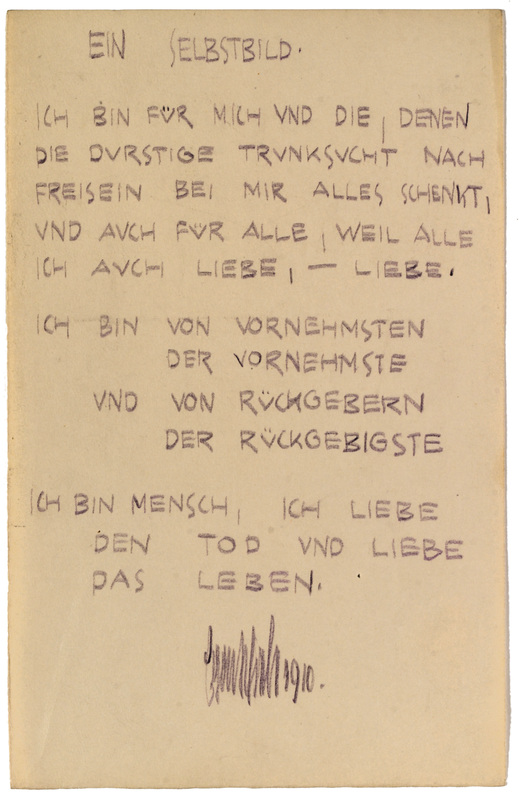
Above is a translation of a poem written by Austrian Expressionist Egon Schiele. While Schiele was a renowned visual artist at the time, he was also a successful lyricist. Schiele did not step far in terms of subject matter concerning his poetry although, majority of his writing revolved around his perception of himself and the world he perceived around him, including his work and way of art making. In the poem Ein Selbstbild (above) Schiele approaches the writing in a clear painterly, art maker way. Even the first line of the poem, “the portrait of the silent pale girl”, correlates very well with Schiele’s drawings of nude female figures. You the viewer, or reader in this case, have the sensibility of looking upon a model as an artist ready to begin your craft, or “encounter her body”. In another poem titled Visions, Schiele’s main focus is the description of a female model in comparison of a landscape, which resonates with a majority of his drawings, paintings, and other styles of work.  The written poem in itself is a work of art, that in my opinion, successfully emphasizes the line that Schiele is so well known for. 

Info and Photo Credit
 “Egon Schiele, Poem "A Self-Portrait", 1910” Masterpieces of the Collection The Leopold Collection Leopold Museum <http://www.leopoldmuseum.org/en/leopoldcollection/focus/Schiele> (May 3, 2016)

Schiele Explores Sexuality


Egon Schiele, in most respects, is well known for his depictions of nude females. That may be sugar coating the subject matter. Egon Schiele’s subject matter consisted mostly of female’s genitalia, and sexual themes. Now that is by no means downplaying or simplifying his work, for they truly are significant works of art. If you were to visit an exhibition of Egon Schiele, I’m sure after the first ten minutes of viewing an excessive amount of women’s breasts and genitals, you would get over it and start to see the similarities within the work and the significance as a piece of art. It is then when you could accept the work or reject it entirely, chopping it up to typical male artist creating “pornography”. I’m not speaking to the latter. Historically, the models from the area that were used for these works of art were not interested in the artists or had any sexual inhibitions about being in a room with a male artist. The center of the human figure is a pivotal point that happens to correlate with the beginnings of life, and sex. But, it is also simply a gratifying location for artist to explore. The human’s pelvis is a fascinating work of art within its self, and Schiele saw that beauty. The pelvis can take on so many positions for countless points of views to produce numerous studies. All of this being said, the subject matter is still loaded with sexuality, and tension between the viewers that cannot be ignored. 


Info and Photo Credit

Werkner, Patrick. Egon Scheile – Art, Sexuality, and Viennese Modernism. California: The Society for the Promotion of Science and Scholarship, 1994.

“Egon Schiele, Semi-Nude Girl with Red Hair” Google Art Project <https://www.google.com/culturalinstitute/asset-viewer/kneeling-girl-resting-on-both-elbows/JgFbSO4YxygRsQ?projectId=art-project>  (May 3, 2016)

Self Portraits


In his unfortunately short lifetime, Egon Schiele has depicted himself in various works of art more than one hundred and seventy times within twenty eight years. During that time Schiele has successfully explored the issues of his own physical identity, and psychological identity. In his piece Nude Self-Portrait, Grimacing, you the viewer are greeted with an ill stricken Schiele whose skin is depicted with ashy grey tones highlighted with crimson lips and areolas. Majority of Schiele’s self-portraits are depicted in this way. Did you ever hear the adage “it doesn’t matter what you look like, it’s what is on the inside that matters”? Well Schiele showed us what was on the inside, and it wasn’t always pretty, unlike academic portraiture that was popular at the time. He described in his work that the image created by looking into the mirror and recreating on canvas, is decay or disintegration of the body. It is with that breakdown of the body that Schiele was better to understand his own mind. A rather creative introspective exorcise that was advanced for his time. An aesthetic that Schiele was known for concerning his portraiture work was the lack of background information, and it comes into play in his self-portraits as well. By eliminating any background information, Schiele forces himself to the foreground and pushes the excessive sense of vulnerability. Egon was known for saying that he “wanted to experience everything”, and I believe by forcing himself (literally) in his work he is successful in that. 

Info and Photo Credit

“Egon Schiele, Nude Self Portrait (undated)” Google  Art Project https://www.google.com/culturalinstitute/asset-viewer/nude-self-portrait-grimacing/UAFiGZvm_vatHA?projectId=art-project  (May 3, 2016)

Zurich, Kunsthaus. Jenny Saville Egon Scheile. Germany: Hatje Cantz Verlag Zeppelinstrasse., 2014.

Austrian Expression

Egon Schiele worked within a movement known as Austrian Expressionism, a movement that emerged from former art movements such as fin de siècle and a more locally known movement referred to as Jugendstil. Schiele’s work historically shows the artifacts of former movements, but he took certain aspects of the former techniques and amplified them. For example, his line cannot go unnoticed. His figures are pushed to the front of the picture plane via heavy contour lines and an absence of background information. It is quite impressive to see such confidence in one’s line work the way Schiele portrays in his works. Another forward quality that his work expresses is the amount of emotional force conceived via color. Using primarily water colors, Schiele would lay yellows, blues, greens, and violets gruffly beside one another. A figures head displayed as bright crimson not only gives the viewer a since of uncomfortableness but a wanting to know more. The same fashion of detail was given to the figures limbs as well. Even more curious is that figures are often composed gesturally with obscured hand signals that hark back to symbolism. Another factor of Schiele’s work, in the sense of expressionism, is the way the figures are arranged. Most of the compositions are that of a nude female, whose body was arranged in a rather erotic manner, expressing what can only be described as “primordial desires” according to Schiele. It is this level of expression that Schiele outweighs, as a psyche work of art, of that of his colleagues. 

Info Credit

Mitsch, Erwin. The Art of Egon Scheile. New York: Phaidon Press Limited., 1975.

Schroder, Klaus A & Sceemann, Harald. Egon Scheile and His Contemporaries – Austrian Painting and Drawing from 1900 to 1930 from the Leopld Collection, Vienna. New York: Neues Publishing Company.,1989.

Sunday, May 1, 2016

Schiele in Prison

On April 13, 1912, Egon Schiele was arrested by Neulengbach police and was imprisoned for twenty four days under the charges of “Immorality” and “Seduction”. During his time in prison Schiele kept a diary, and was also able to continue to create work.  The charges, at the time, seemed to be unfair in the artists’ eyes. Schiele claims that even though his work is generally erotic in nature, the portraits of young females were erotic but also had artistic merits. Below is an excerpt from Schiele’s diary that explains his point of view in greater detail.

-Another Day, A May Day!
I do not deny it: I have made drawing and watercolors that are erotic. But they are still always works of art- that I can attest, and people who understand something of this will gladly affirm it. Have other artists made no erotic pictures? Felicien Rops, for example, made only such kinds. But one has never imprisoned an artist for this. No erotic work of art is filth if it is artistically significant; it is only turned into filth through the beholder if he is filthy. I do not understand how it has happened and I do not understand why it has happened. I have not corrupted children, for I did not show them these pictures, and as for adults, they know these things very well anyway. Why, then? I am not at all an evil man! I have not ravished, stolen, murdered, set fires-nor in any other way offended the sensitive human “society” – except by my existence.


Schiele was released on May 8, 1912, and while he was not indicted for any crimes of immorality or seduction, during his hearing the judge burned the confiscated drawing as a further punishment. 


Photo & Information Credit

Comini, Alessanndra. Scheile in Prison. Connecticut: New York Graphic Society Ltd., 1973.
“Egon Schiele (1890 – 1918)” Pinterest < https://www.pinterest.com/evesze/egon-schiele-1890-1918-was-an-austrian-painter/> (May 1, 2016)

Thursday, April 28, 2016

Egon's Kiss

Cardinal and Nun (Caress) (1912)
by Egon Schiele
Leopold Museum, Vienna

Gustav Klimt was a well renowned “Art Nouveau” artist working in Germany during the early 1900’s.  Upon seeing the work of Gustav Klimt from an exhibition in 1907, Schiele started to mimic the artists’ style and techniques. The relationship between the two artists however, has been overly romanticized from multiple biographies, and mixed sources. Schiele studied Klimt’s work and produced many works of art mimicking the artist until a style of his own was established. One of the conflicting techniques that Schiele uses, that differs from Klimt, from his portraiture work is the absence of an ornate background. Instead, the figure is forced to front of the picture plane, void from any background information and left vulnerable. The piece Cardinal and Nun and clearly a take on Klimt’s Kiss. Many differences can be noticed within Schiele’s Cardinal and Nun. Just as mentioned earlier, the ornate background was exchanged for a solid black hue lacking of any formal information. An obvious difference between the two is the expression on the nun’s face compared to the woman portrayed in Kiss. In Schiele’s work, the woman is not accepting of the embrace, and has a look of fear or horror. Unlike Klimt’s Kiss, the embrace itself is portrayed as unwanted as well. Hands from both figures are now awkwardly placed on one another. While the sexual tension of Schiele’s work is generally more forward and literally centered on the canvas, Cardinal and Nun seems to come off as a calmer, yet darker, sense of sexual exploration.   

Photo & Information Credit

Kallir, Jane. Egon Scheile – Drawings and Watercolors. New York: Thames & Hudson Inc., 2003.


Egon Schiele, Cardinal and Nun (Caress)” Masterpieces of the Collection The Leopold Collection Leopold Museum <http://www.leopoldmuseum.org/en/leopoldcollection/masterpieces/34 > (April 28, 2016)